

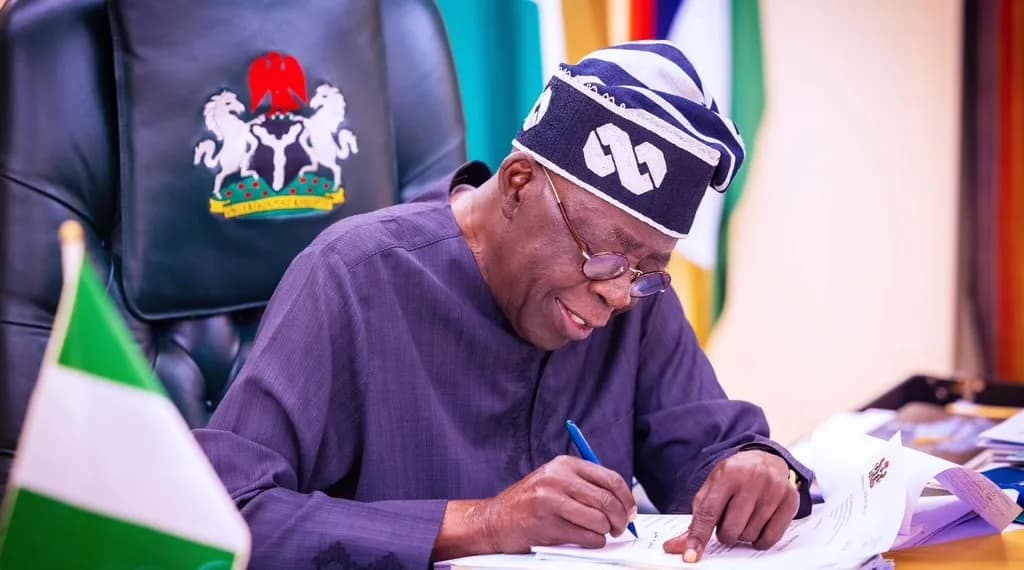
President Bola Ahmed Tinubu on Wednesday signed into law the Electoral Act, 2022 (Repeal and Re-Enactment) Bill 2026, despite widespread criticism and protests in parts of the country, including Abuja.
The bill was passed by the National Assembly a day earlier after months of public debate, political tension, and intense deliberations by lawmakers. Its passage, however, sparked controversy, particularly over provisions relating to the electronic transmission of election results.
Tension in the Senate
At the Senate, proceedings became heated during consideration of Clause 60, which addresses what happens if electronic transmission of results fails. Senator Enyinnaya Abaribe (ADC, Abia South) demanded a formal division (recorded vote) on the clause, leading to a rowdy session in the chamber.
Senate President Godswill Akpabio initially suggested that the request for division had already been withdrawn. Opposition senators disagreed, insisting that the matter was still active and required a proper vote.
Deputy Senate President Barau Jibrin cited Order 52(6) of the Senate Standing Orders, arguing that it would be procedurally wrong to revisit a decision already ruled upon. His intervention further heightened tensions in the chamber.
Senate Leader Opeyemi Bamidele clarified that he had earlier moved a motion to rescind the bill’s passage, meaning previous decisions had been set aside. He maintained that Abaribe’s request for a division was therefore valid.
Rising under Order 72(1), Abaribe specifically objected to Clause 60(3), which allows manual transmission of results using Form EC8A if electronic transmission fails. He argued that keeping the manual option could weaken electoral transparency and create room for manipulation.
When the vote was finally conducted, 55 senators supported retaining the clause, while 15 voted against it. As a result, the controversial provision allowing manual transmission in the event of network failure remained in the bill.
Concerns Over 2027 Elections
Earlier in the session, senators had moved to rescind the bill’s earlier amendment due to concerns about inconsistencies and the timing of the 2027 general elections.
According to Bamidele, the Independent National Electoral Commission (INEC) had announced February 2027 for the next general elections after consultations with National Assembly leaders. However, some lawmakers noted that Clause 28 of the bill requires elections to be held at least 360 days before the expiration of tenure, creating a possible conflict.
There were also concerns that holding elections during the Ramadan period could affect voter turnout, logistics, and overall participation.
In addition, lawmakers pointed out discrepancies between the bill’s Long Title and several clauses, including Clauses 6, 9, 10, 22, 23, 28, 29, 32, 42, 47, 51, 60, 62, 64, 65, 73, 77, 86, 87, 89, 93, and 143.
Drama in the House of Representatives
The controversy was not limited to the Senate. The House of Representatives also witnessed chaos when opposition lawmakers protested attempts to rescind parts of the Electoral Act (Amendment) Bill.
The tension began after Francis Waive, Chairman of the House Committee on Rules and Business, moved a motion to reverse the House’s earlier approval of the bill, which had been passed in December 2025. The main point of disagreement again centered on Clause 60(3), which mandates compulsory electronic transmission of results from polling units to collation centres.
When Speaker Tajudeen Abbas put the motion to a voice vote, opposition lawmakers objected, arguing that the “nays” were louder than the “ayes.” Despite the protests, Abbas ruled in favor of the “ayes,” triggering accusations of bias and procedural irregularities.
An executive (closed-door) session was called to restore order, but tensions persisted when lawmakers returned to the chamber. The session soon became rowdy, with some members physically preventing Deputy Speaker Benjamin Kalu from continuing proceedings.
Eventually, several opposition lawmakers staged a walkout, chanting protests as they left the chamber, leaving the plenary session nearly empty.
Public Reaction
The bill has continued to generate mixed reactions nationwide. Supporters argue that the law provides flexibility in situations where technology fails. Critics, however, insist that retaining manual transmission as an alternative could undermine the credibility and transparency of Nigeria’s electoral process.
With the President’s assent, the Electoral Act (Repeal and Re-Enactment) Bill 2026 is now law, setting the stage for its implementation ahead of the 2027 general elections.
